
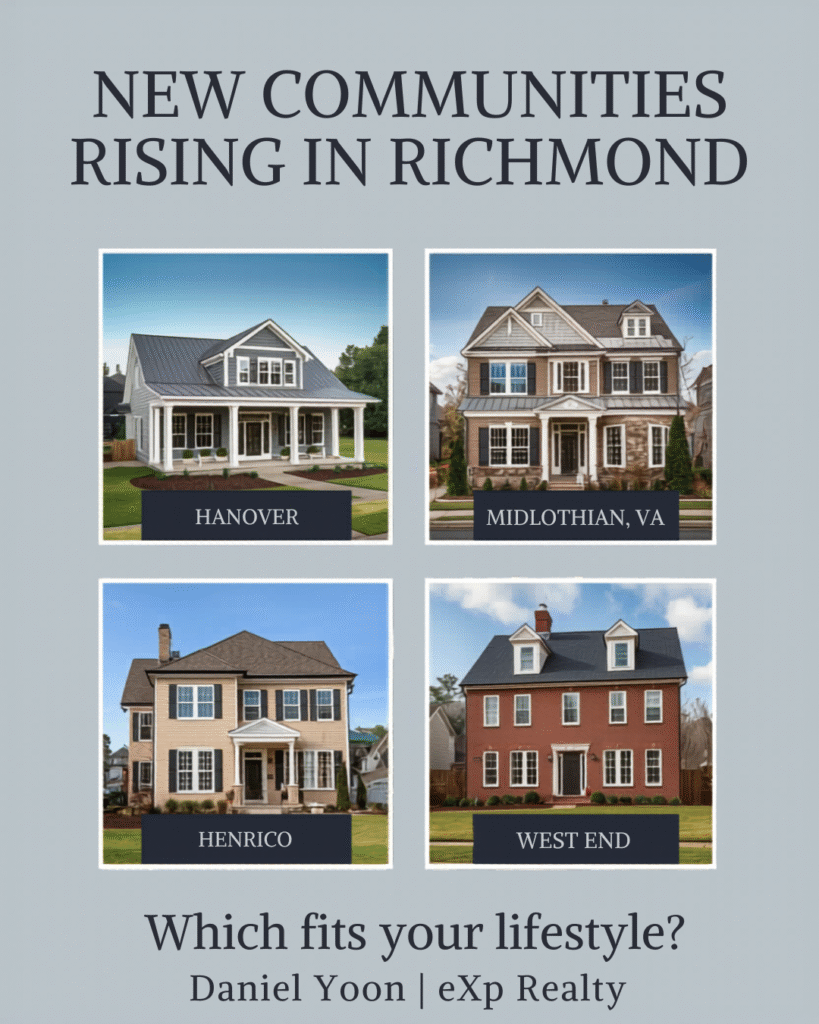
by Daniel Yoon | eXp Realty | Richmond, Virginia
If you are relocating to Richmond, Virginia in 2026, you are making a smart move. Richmond’s cost of living runs 5% to 6% below the national average, the job market is anchored by major employers like Capital One, VCU Health, Altria, and CarMax, and the housing market offers genuine value compared to DC, Charlotte, and Raleigh. I moved here myself and bought two homes before age 30. This city rewards people who do their research before they arrive.
This guide is written from a realtor’s perspective because most relocation guides skip the part that matters most: where to live, what homes cost, and how to buy smart when you are new to an area.
Why People Are Moving to Richmond in 2026
Richmond is pulling people from three directions right now. DC transplants priced out of Northern Virginia. Remote workers from Northeast cities looking for better quality of life. And military families connected to Fort Barfoot, Joint Base Langley-Eustis, and defense contractors in the region.
What they find when they get here: a mid-size city with a surprisingly strong food scene, access to mountains and beaches within two hours, a real arts and music culture, and homes that cost a fraction of what they left behind. A $500,000 budget that gets you a townhouse in Arlington buys a 4-bedroom home with a yard in Glen Allen or Short Pump.
Cost of Living in Richmond VA
Here is what you should budget when planning your move to Richmond, Virginia:
- Housing: Median home price $395,000 to $420,000. Average rent for a 2-bedroom: $1,350 to $1,500/month. Housing costs run roughly 19% below the national average.
- Utilities: Electric, gas, water, and internet average $250 to $300/month for a single-family home.
- Groceries: Nearly identical to the national average. Wegmans, Publix, Trader Joe’s, Aldi, and Lidl all have locations throughout the metro.
- Healthcare: 8% below the national average. VCU Health, Bon Secours, and HCA Virginia provide strong hospital networks.
- Transportation: Richmond is car-dependent. Budget for gas and car insurance. No significant public transit outside GRTC bus routes in the city.
A single adult can live comfortably in the Richmond area on $48,000 to $55,000 per year. A family of four with two working adults typically needs $110,000 to $130,000 combined to own a home and live comfortably in a good school district.
Where to Live: A Neighborhood Breakdown for Newcomers
This is where relocation guides usually fail. They list neighborhoods without telling you who each one is actually for. Let me fix that.
If You Want Top Schools and Suburban Convenience: Short Pump or Glen Allen
West Henrico County. Home prices: $380,000 to $540,000. Deep Run High School is top 10 in Virginia. Newer homes, excellent shopping, 20 to 30 minute commute to downtown. This is where most relocating families with school-age kids land. Read our Short Pump Guide and Glen Allen Guide.
If You Want Value and Space: Chesterfield
South and southwest of the city. Home prices: $300,000 to $475,000. More house per dollar than anywhere in the metro. Strong schools in the Midlothian corridor. Good option for families on a budget who still want quality neighborhoods. Read our Chesterfield Guide.
If You Want Best Schools at the Best Price: Hanover
North of Richmond. Home prices: $350,000 to $450,000. Atlee High School ranks top 15 in Virginia. Growing communities, new construction with strong builder incentives. Quiet, more rural feel. Read our Hanover Guide.
If You Want Urban Energy and Walkability: The Fan or Museum District
Central Richmond. Home prices: $400,000 to $700,000. Historic row homes, walkable to restaurants, bars, galleries. Tree-lined streets with genuine character. Best for young professionals, couples, and people who value culture over square footage.
If You Want Affordable Entry Into the Market: Eastern Henrico
East of downtown. Home prices: $180,000 to $325,000. Older homes, appreciating fast. Best for first-time buyers and investors. Lower school ratings than west Henrico but improving. Read our Henrico Guide.
Property Taxes: What Relocators Need to Know
Property tax rates vary significantly across the Richmond metro. This catches many relocators off guard.
- City of Richmond: $1.20 per $100 of assessed value (highest in the metro)
- Chesterfield County: $0.91 per $100
- Henrico County: $0.83 per $100
- Hanover County: $0.81 per $100 (lowest in the metro)
On a $400,000 home, the annual property tax difference between Hanover ($3,240) and the City of Richmond ($4,800) is $1,560 per year. Over 10 years, that is $15,600. Where you buy matters for more than just lifestyle.
Henrico County also does not charge personal property tax on the first $20,000 of vehicle value, saving a two-car family roughly $1,000+ per year compared to the City of Richmond.
The Relocation Home Buying Timeline
3 to 6 Months Before Your Move
- Connect with a local realtor who knows the Richmond market (that is what I do)
- Get pre-approved with a lender. If you are military, explore VA loan options
- Research neighborhoods based on your commute, school needs, and lifestyle
- Start virtual tours. I can do video walkthroughs of homes while you are still out of state
1 to 3 Months Before
- Plan a house-hunting trip (2 to 3 days minimum). I will build an itinerary of 8 to 12 homes plus neighborhood tours
- Narrow to 2 to 3 neighborhoods based on your visit
- Make an offer and begin the closing process
30 Days Before
- Finalize your mortgage and schedule closing
- Set up utilities (Dominion Energy for electric, various providers for gas and water depending on county)
- Register vehicles and obtain Virginia driver’s license within 60 days of moving
- Enroll kids in school
Jobs and Economy
Richmond’s job market is diversified, which is why it has weathered economic downturns better than many cities. Major employers include:
- Capital One: Headquarters in McLean but major operations in Richmond (West Creek campus in Goochland)
- VCU Health System: One of the largest employers in the metro
- Altria Group: Corporate headquarters in Henrico County
- CarMax: Corporate headquarters in Richmond
- Federal Reserve Bank of Richmond: Downtown
- State government: Richmond is Virginia’s capital
- Defense sector: Fort Barfoot, DISA, defense contractors throughout the region
Unemployment in the Richmond metro is consistently below the national average. The tech sector is growing, healthcare is expanding, and the financial services industry has deep roots here.
What Relocators Always Ask Me
How does Richmond compare to Northern Virginia or DC?
Richmond costs roughly 35% to 45% less than the DC metro for housing. A family that rents a 2-bedroom apartment for $2,800 in Arlington can buy a 4-bedroom home in Glen Allen for the same monthly payment. The tradeoff is career options. If your job requires in-person DC presence, the 100-mile commute is not practical. But if you work remotely or in a Richmond-based industry, the value is massive.
Is Richmond safe?
Like any city, safety varies by neighborhood. The suburbs (Henrico, Chesterfield, Hanover, Short Pump, Glen Allen) have very low crime rates comparable to any suburb in the country. Parts of the city itself have higher crime statistics, but neighborhoods like The Fan, Museum District, and Church Hill are considered safe and walkable. I can give you specifics on any neighborhood you are considering.
What about the weather?
Richmond has four distinct seasons. Summers are hot and humid (mid-80s to low 90s, July and August). Winters are mild by Northeast standards (30s to 40s, occasional snow). Spring and fall are genuinely beautiful. If you are coming from the Northeast, you will appreciate the milder winters. If you are coming from the South, summers will feel familiar.
Can I find a home without visiting in person?
Yes, but I recommend at least one trip before closing. I do video tours, FaceTime walkthroughs, and drone flyovers for out-of-state clients. Several of my relocation clients have made offers based on virtual tours and then done their in-person visit during the inspection period. It works, but nothing replaces walking the neighborhood yourself.
How long does it take to close on a home in Richmond?
Typical closing timeline in the Richmond, Virginia market is 30 to 45 days from accepted offer. New construction takes 6 to 9 months if you are building. If you need to close faster, cash offers or streamlined lender processes can close in 14 to 21 days.
Planning a move to Richmond? Call Daniel Yoon at (804) 896-2694 or visit danielyoonrealty.com. I specialize in helping relocating families find the right neighborhood and the right home. Let me build a personalized plan for your move.