


Richmond is one of the more workable mid-Atlantic relocations in 2026. The metro offers more square footage and lower property taxes than Northern Virginia, more economic diversity than the smaller Tidewater markets, and a school and amenity base that compares favorably with mid-sized cities elsewhere on the East Coast.
This guide is for buyers planning a move from out of state, whether for a job, family, or lifestyle reasons. The goal is concrete: where to live, what to expect on the housing side, what taxes and schools look like, and how to time the search and the close.
What Richmond is, in 2026 terms
Three things to know going in:
- The metro is growing. Chesterfield County added 36,753 residents since 2020, the largest raw population gain in Virginia [verify HBAR]. Hanover and Henrico continue steady growth. New Kent County is up 21.5% by percentage [verify], the fastest-growing in the state.
- The market is more balanced than 2022. Inventory is up. Days on market is around 24 in early 2026 [verify Redfin]. Sellers are paying concessions in most price bands.
- The price points are workable for most relocators. Median Richmond regional home value is approximately $415,000 [verify Zillow / Redfin], with strong inventory in the $300,000 to $600,000 band and a real luxury market above $1 million.
For broader market context, see is now a good time to buy in Richmond.
Where to live: by lifestyle
Family-oriented suburbs with strong schools
- Short Pump and Glen Allen (Henrico): the most-asked-about family suburb. Strong schools (Deep Run High zone), close to retail and dining, easy commute to Innsbrook and downtown.
- Midlothian (Chesterfield): strong family suburb with two well-regarded high schools (Midlothian and James River). More space than Short Pump, slightly longer commute to downtown.
- Mechanicsville (Hanover): historic-feeling suburb just northeast of the city, with a mix of established neighborhoods and newer construction. Good for families wanting a less master-planned feel.
Walkable urban living
- The Fan: historic 19th-century rowhouses, walkable to downtown, restaurants, museums. Older homes, smaller lots.
- Museum District: adjacent to the Fan, similar feel, walking distance to the Virginia Museum of Fine Arts.
- Manchester (south of the river): revitalized industrial neighborhood with a growing condo and townhouse market.
- Scott’s Addition: former industrial area transformed into breweries, restaurants, and modern residential.
Luxury and large-lot living
- West End city neighborhoods (Windsor Farms, Hampton Hills, River Road): older luxury, mature trees, walkability. See Richmond’s West End luxury neighborhoods.
- Wyndham (Glen Allen): master-planned with country club. See living in Wyndham.
- Hallsley (Chesterfield) and Kinloch (Goochland): newer luxury options. See Hallsley vs Kinloch.
- Hanover and Goochland larger acreage: for buyers wanting one to ten acres with country feel.
First-time buyer-friendly options
- Eastern Henrico (Varina): lower entry price, growing area, strong upward trajectory.
- Chesterfield growth corridor (Chester, Moseley): new construction at lower price points than Short Pump or Midlothian.
- Lakeside (Henrico): older neighborhoods inside Henrico with smaller homes and shorter commutes to downtown.
For a first-time buyer guide specific to Henrico, see buying your first home in Henrico step by step.
Cost of living: a fair comparison
For a relocator coming from a higher-cost-of-living metro, Richmond delivers materially more on the housing side and roughly comparable everything else.
Housing
- $750,000 in Northern Virginia: small townhouse or older suburban home. In Richmond’s West End or Wyndham, a renovated single-family with strong schools and three-car garage.
- $750,000 in DC, Boston, or coastal California: condo or smaller home. In Richmond, mid-tier luxury in many neighborhoods.
Property taxes
- Richmond city: $1.20 per $100 [verify]
- Henrico: $0.85 per $100 [verify]
- Chesterfield: $0.89 per $100 [verify]
- Hanover: $0.79 per $100 [verify]
- Goochland: $0.50 per $100 [verify]
For a $700,000 home, that is $3,500 to $8,400 annually in real estate tax depending on locality. See property taxes in Richmond, Henrico, and Chesterfield.
State income tax
Virginia’s marginal rate tops out at 5.75%. Lower than most Northeast states; higher than Florida or Texas (no state income tax).
Other costs
Groceries, gas, dining, and services in Richmond tend to run modestly below national average.
Schools: the basics
Henrico County Public Schools and Chesterfield County Public Schools both run strong systems with multiple highly-ranked high schools. Hanover and Goochland counties run smaller, more tightly-knit systems. Richmond Public Schools (RPS) varies materially by school, with strong specialty programs and some traditional schools that vary widely.
For buyers prioritizing public schools, the Far West End of Henrico (Deep Run High zone) and central Chesterfield (Midlothian and James River zones) are the most consistent strong feeders. See top public school zones in Henrico and Chesterfield.
Commute reality
Richmond is one of the more workable commute markets on the East Coast.
Typical 2026 commute times to downtown Richmond:
- Short Pump: 25 to 35 minutes
- Glen Allen / Wyndham: 25 to 40 minutes
- Midlothian: 25 to 40 minutes
- Hallsley: 30 to 45 minutes
- Mechanicsville: 25 to 35 minutes
- The Fan or Museum District: under 15 minutes
- Goochland (Kinloch): 30 to 40 minutes
Most relocators from larger metros find these commutes notably easier than what they left.
The relocation home-buying timeline
A practical timeline for an out-of-state buyer:
Phase 1: pre-visit (weeks 1 to 2)
- Get pre-approved with a Virginia-licensed lender (some have remote-friendly processes). See pre-approval vs pre-qualification.
- Pick a Richmond-area buyer’s agent. Interview at least two.
- Define non-negotiables: commute, school zone, price band, lot, style.
- Map two to three target neighborhoods.
Phase 2: discovery visit (one to three days on the ground)
- Driving tour of target neighborhoods at the actual commute times
- Five to ten home tours with the agent
- Conversations with current residents where possible
- Drive the schools, drive the grocery, drive the daily life
Phase 3: focused search and offer (weeks 4 to 8)
- Saved searches with the agent
- Virtual tours of new listings
- Second visit if needed
- Offer with appropriate contingencies. See escalation clause and appraisal gap guide.
Phase 4: contract through close (30 to 45 days)
- Inspection (handle remotely with attendance via video, or fly back). See Virginia home inspection guide.
- Loan finalization
- Final walk-through
- Closing (most lenders allow remote closings via mobile notary or attorney-handled closings)
Most relocators close on a Richmond-region home within sixty to ninety days of starting the search.
What relocators get wrong
A few common patterns to avoid:
- Underestimating commute differences within the metro. Short Pump to downtown at 8am is meaningfully different from Glen Allen to Innsbrook at 8am.
- Choosing a neighborhood entirely from online research without visiting. Photos and maps lie.
- Anchoring on prices from the previous metro. A $500,000 Richmond home is not a $500,000 home in DC or Boston.
- Skipping the school-zone confirmation. Specific addresses determine schools, not neighborhood reputation.
- Trying to time the rate market. Most relocators do better closing on the right home and refinancing later if rates drop.
Frequently asked questions
What is the cost of living in Richmond compared to DC? Materially lower on housing. Roughly comparable on most other categories. Income taxes are similar (Virginia marginal 5.75% vs DC’s 8.75% top). Property taxes are lower outside the city.
Are Richmond schools good? Henrico, Chesterfield, Hanover, and Goochland all run strong public school systems. Specific schools vary; check the address-specific zone before deciding.
Where do most out-of-state professionals move to in Richmond? Short Pump, Glen Allen, Midlothian, the Fan, and Manchester are the most-asked-about destinations.
How long does it take to buy a home as an out-of-state relocator? 60 to 90 days from search start to closing in most cases.
Can I buy a Richmond home remotely? Yes. Most steps can be handled remotely with video tours, electronic document signing, and mobile-notary closings. One to two in-person visits is typical.
What is the property tax rate in Richmond, VA? $1.20 per $100 in the city; $0.85 to $0.92 in surrounding counties. See property taxes guide for details.
Want a relocator-specific home search?
We work with relocating buyers regularly. If a relocation consultation that covers neighborhoods, schools, taxes, commutes, and the buying timeline would help, reach out to Daniel.
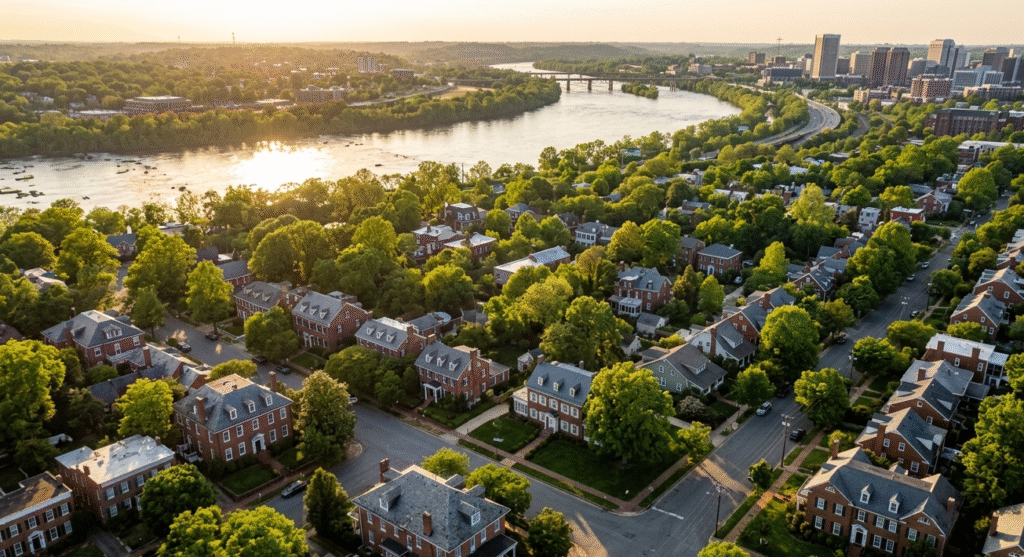
[Featured image to upload. Image prompt: Photoreal aerial drone shot of the Richmond Virginia skyline at dusk, the James River curving through the foreground, downtown towers and historic Church Hill rowhouses visible, golden hour, no people, editorial real estate photography]